By Dr. Logan Chopyk – Spectrum Sound Studio
Every brass player eventually encounters a barrier so stubborn that no amount of traditional practice seems to help. Some struggle with chronic tension. Others find themselves locked into inefficient breathing patterns. For a small but significant group—especially those experiencing severe imbalance or focal task-specific dystonia—the very act of picking up the trombone can trigger an involuntary, dysfunctional movement pattern.
These walls feel immovable.
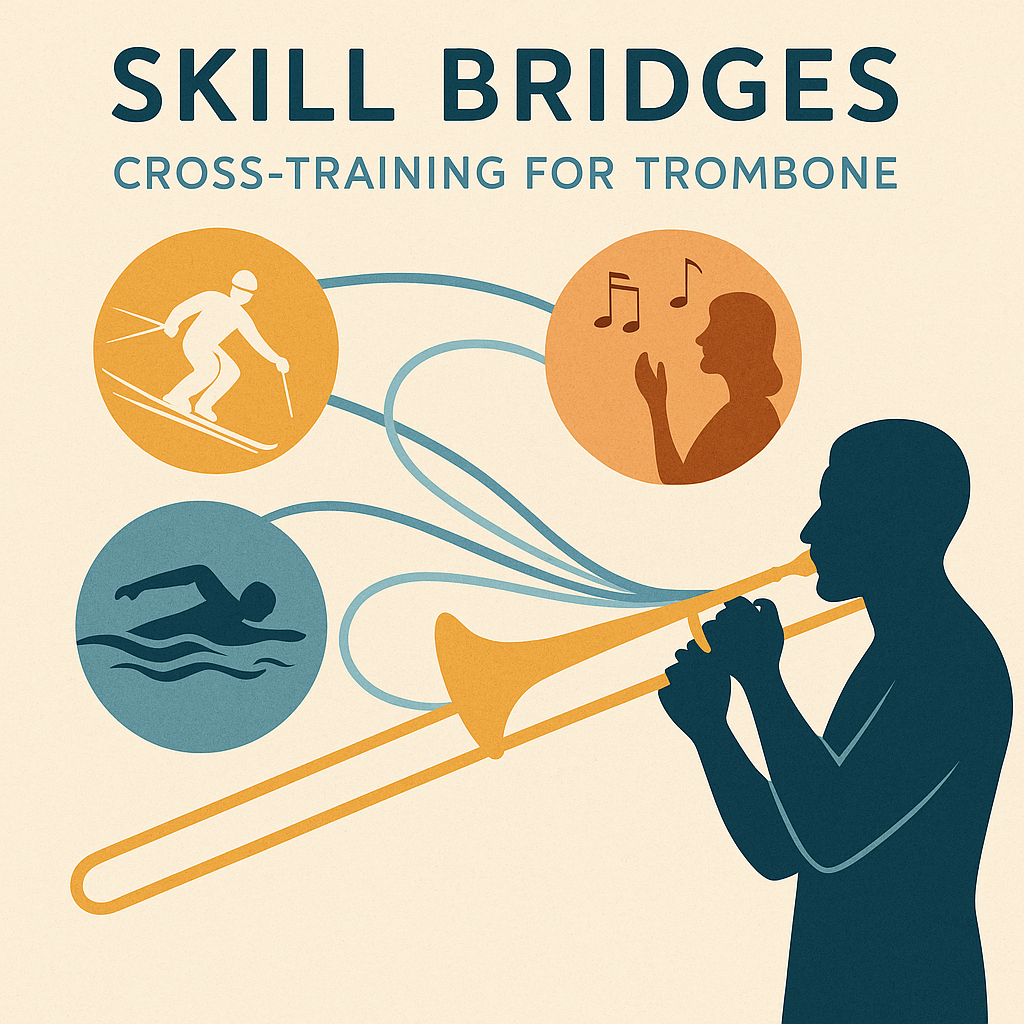
But Skill Bridges offer a way through.
Skill Bridges—intentional connections between non-trombone activities and core brass-playing skills—allow players to retrain movement patterns without triggering the neural pathways that reinforce the problem. For players who feel stuck, plateaued, or overwhelmed by technical issues, these parallel experiences can unlock natural, efficient, expressive music-making in ways traditional practice simply cannot.
This article explores how Skill Bridges become the most powerful tool we have for breaking through deeply entrenched barriers.
Why Some Problems Can’t Be Fixed on the Trombone
When a movement pattern becomes tightly bound to the context of playing trombone, the nervous system treats the instrument itself as a cue:
- The player picks up the instrument → the imbalance activates
- The brain anticipates the problem → tension increases
- The player tries harder to correct it → the pattern strengthens
- Paralysis by analysis takes over → artistry collapses
This cycle is especially strong in long-term habits, severe imbalances, and focal dystonia, where internal focus and micromanagement actually worsen symptoms.
Skill Bridges bypass the trigger.
They create a new environment where the player can experience healthy, efficient, resonant movement without the neurological baggage associated with the trombone.
This resets the system and builds a new, more functional pattern that can later be transferred back to the instrument.
Skill Bridges That Break Through Even the Toughest Barriers
1. The Straw: Effortless Breath Flow Without Triggering Tension
Blowing into a straw gives players access to healthy airflow that often becomes impossible the moment they pick up the instrument.
A straw produces:
- Free, continuous outward air
- A small, external target
- A clear acoustic response when it resonates
Once the player experiences this effortless flow, they can copy-paste the movement back onto trombone playing, bypassing years of bracing, gripping, or tense breathing habits.
For some players—especially those struggling with focal dystonia—this is the first time they’ve felt real breath freedom in years.
2. The Pinwheel: M. Dee Stewart’s Simple but Brilliant External Focus Tool
M. Dee Stewart of Indiana University famously used a pinwheel to liberate airflow and phrasing.
Players would blow musical lines on the pinwheel—no mouthpiece, no slide, no technical instructions. The pinwheel naturally reinforces:
- Continuous airflow
- Phrase-level musical thinking
- External focus (“blow the tune on the pinwheel”)
- Breathing without overthinking mechanics
Then, when the player returns to the trombone, the body remembers the feeling of flow instead of force.
This external focus dramatically reduces the internal micromanagement that paralyzes so many players.
3. Sports Visualization: A Bridge from Athletic Intuition to Musical Intention
Athletes routinely visualize trajectories, arcs, and destination points—the path of a golf ball, the shape of a ski turn, the apex of a cycling curve. This type of visualization:
- Directs attention outward
- Reduces mechanical overthinking
- Organizes the body automatically
- Creates movement based on intention, not tension
For musicians stuck in analytical over-control, adopting a sports-style visualization practice helps reestablish natural, efficient motor patterns.
Imagine the shape of the phrase, how the air moves freely in the pipe and rides the sound at the bell. The body follows the imagined outcome without micromanaging mechanics.
4. Switching Instruments: Revealing Hidden Tension Patterns
Switching between tenor and bass trombone exposes habits that feel invisible on one instrument but obvious on the other.
On bass trombone, players simply cannot get away with:
- Chest-driven force
- Throat compression
- Overblowing
Bass trombone playing demands ease and simplicity.
A few minutes of relaxed, resonant bass trombone playing often resets the entire system, allowing the player to return to tenor with improved airflow, balance, and resonance.
This is one of the most effective Skill Bridges for diagnosing and interrupting hidden imbalances.
5. Flute: The Most Revealing—and Transformative—Skill Bridge
Flute might be the single best parallel activity for trombonists.
It is similar enough to transfer (same direction of airflow, same breath intention), yet different enough that brass-related bad habits become immediately apparent and unusable.
Flute exposes:
- Chest tension
- Throat manipulation
- Overblowing
- Unnecessary embouchure movements
- Movement patterns that block airflow
Flute requires:
- Pure, unforced air
- Clear external focus on the edge of the tone hole
- Ease, resonance, and balance
Spending just 20 minutes on flute before trombone practice helps to:
- Eliminate manipulative breath habits
- Promote natural resonance
- Reinforce external focus
- Mimic the “sound membrane” sensation at the trombone bell
- Erase years of accumulated tension patterns
Flute playing gives the player honest feedback. It makes bad habits impossible and good habits obvious.
Why Skill Bridges Work When Nothing Else Does
Skill Bridges succeed where instrument-based corrections fail because they access entirely new neural pathways. They rely on principles from motor learning and neuroscience:
1. External Focus Boosts Performance and Reduces Tension
(Gabriele Wulf, OPTIMAL Theory)
Players focusing on sound, airflow, or outcomes perform better than players focusing on body parts.
2. Practice Variability Enhances Transfer
(Research on contextual interference)
Learning is deeper and more adaptable when the brain is challenged in different contexts.
3. Embodied Analogies Simplify Complex Motor Skills
Rather than imagining a metaphor (“play like flowing water”), the player performs one (skiing, skating, blowing a pinwheel).
4. Avoiding Dystonic Triggers Allows Relearning
When the trombone triggers dystonia, learning must happen elsewhere first.
Skill Bridges are that “elsewhere.”
The Big Idea: Skill Bridges Can Shave Years off the Learning Process
Most musicians believe progress depends on:
- More practice
- More repetition
- More instructions
- More willpower
But when the nervous system is stuck, more effort deepens the rut.
Skill Bridges offer a different path—one that accelerates learning by tapping into movement patterns your body already knows how to execute with ease.
They allow players to:
- Rediscover free, resonant airflow
- Rebuild healthy coordination
- Escape dysfunctional habits
- Reconnect with musical intention
- Experience the joy and artistry of playing without strain
If you want faster, healthier, more meaningful growth, Skill Bridges are not optional—they are essential.
Interested in Exploring Skill Bridges in Your Own Playing?
I work with players of all levels—beginners to top professionals—both in person and online through Spectrum Sound Studio
If you’re facing tension, inconsistency, overthinking, or even focal dystonia, there are ways forward. Often the breakthrough comes not from more practice, but from the right parallel activity that finally unlocks the movement you’ve been searching for.
Sometimes the most powerful musical breakthroughs begin in unexpected places:
a straw, a pinwheel, a sports visualization, a bass trombone, or a simple 20-minute session on flute.
Annotated Bibliography
Benade, Arthur H. Fundamentals of Musical Acoustics. 2nd ed. New York: Dover, 1990.
Definitive text on the acoustics of brass instruments, explaining standing waves, reflection, and why the horn—not the lips—drives vibration.
https://press.uchicago.edu/ucp/books/book/distributed/F/bo5954978.html
Coker, Cheryl A. Motor Learning and Control for Practitioners. New York: Routledge, 2021.
Clear overview of motor learning concepts including transfer, practice variability, and attentional focus—foundational for the Skill Bridges model.
https://www.routledge.com/Motor-Learning-and-Control-for-Practitioners/Coker/p/book/9780367430876
Csikszentmihalyi, Mihaly. Flow: The Psychology of Optimal Experience. New York: Harper & Row, 1990.
Explores flow states and the conditions that enable optimal performance—highly relevant to brass pedagogy and external focus.
https://www.harpercollins.com/products/flow-mihaly-csikszentmihalyi
Wulf, Gabriele. Attention and Motor Skill Learning. Champaign, IL: Human Kinetics, 2007.
Seminal text demonstrating the power of external focus for improving performance and reducing tension.
https://us.humankinetics.com/products/attention-and-motor-skill-learning
Wulf, Gabriele, and Rebecca A. Lewthwaite. “Optimizing Performance Through Intrinsic Motivation and Attention for Learning: The OPTIMAL Theory of Motor Learning.” Psychonomic Bulletin & Review 23, no. 5 (2016): 1382–1414.
Explains how attention, motivation, and intention shape motor performance—supports Skill Bridge applications.
https://link.springer.com/article/10.3758/s13423-015-0999-9
Fletcher, Neville H., and Thomas D. Rossing. The Physics of Musical Instruments. 2nd ed. New York: Springer, 1998.
Highly respected scientific explanation of instrument acoustics, including brass resonance and standing waves.
https://link.springer.com/book/10.1007/978-1-4419-3123-2
Nieuwenhuys, Arne, and Geert J. P. Savelsbergh. “The Role of Visual Anticipation in Sports Performance.” International Review of Sport and Exercise Psychology 5, no. 1 (2012): 23–35.
Explains sports visualization, trajectory planning, and the neural mechanisms behind external focus— directly applicable to musical phrasing.
https://www.tandfonline.com/doi/abs/10.1080/1750984X.2011.630469
Altenmüller, Eckart, and Hans-Christian Jabusch. “Focal Hand Dystonia in Musicians: Phenomenology, Pathophysiology, Triggering Factors, and Treatment.” Medical Problems of Performing Artists 24, no. 1 (2009): 3–9.
Key overview of focal dystonia and why traditional practice often worsens symptoms—supports the need for Skill Bridges in rehabilitation.
https://journals.sagepub.com/doi/10.1177/0022429409338742
Stewart, M. Dee. “Pedagogical Approaches to Breath and Flow in Trombone Teaching.” Indiana University Brass Department Archives.
Documents Stewart’s influential use of pinwheels and external-focus exercises to promote natural airflow. (Archival reference; not publicly hosted.)
Schmidt, Richard A., and Tim Lee. Motor Control and Learning: A Behavioral Emphasis. 6th ed. Champaign, IL: Human Kinetics, 2019.
The authoritative text on motor learning, contextual interference, and skill transfer—central to the Skill Bridges framework.
https://us.humankinetics.com/products/motor-control-and-learning-6th-edition-with-web-study-guide