Author: Logan Chopyk, DM
-
Reframing Success: How Focal Dystonia Taught Me How To Teach Autistics
By Dr. Logan Chopyk I specialize in teaching music to autistic individuals. Over the years, I’ve found that a vast majority of the most effective strategies I use didn’t come from a standard music education curriculum. Instead, they came from a vastly different realm: coaching musicians retraining from Focal Dystonia. Many of the insights gained Read more
-
Tip for Beginner Brass Players: Play Loud!
By Dr. Logan Chopyk I was honored to spend all day yesterday coaching a local middle school band program’s low brass players. Working with these students is always a rewarding experience, but it also highlighted a trend that I think is fairly universal for players of this age and experience level: the tendency to play softly Read more
-
Effective Music Practice: Organizers, Apps, and the Science of Self-Regulated Learning
By Dr. Logan Chopyk, DM As a music educator, one of my primary goals is to foster independence in my students. Whether I am working with an advanced brass player preparing for an audition or guiding a neurodivergent student through adaptive piano lessons, the time spent in the studio is only a fraction of the Read more
-
The Universal Classroom: Why Great Teaching Knows No Neurotype
By Dr. Logan Chopyk If you spend enough time in any faculty breakroom, you will inevitably hear a familiar chorus of complaints. “Why can’t they be more mature?” “Why don’t they just get this?” “They should be further along by now.” As educators, we all need a safe space to decompress and vent, and the day-to-day challenges Read more
-
Is Multi-instrumentalist Jacob Collier the Ultimate Musical Role Model?
Is Multi-instrumentalist Jacob Collier the Ultimate Musical Role Model? When Jacob Collier released In My Room in 2016, the music world didn’t just witness a new artist; it witnessed a case study in extreme multi-instrumentalism. Performing, singing, and producing every note from his childhood bedroom, Collier became the poster child for a “total” musicality. But Read more
-
Part 3: Righting the Ship – Protocols for Neuro-Metabolic Recovery
Part 3: Righting the Ship – Protocols for Neuro-Metabolic Recovery By Dr. Logan Chopyk In Part 2, we confronted a difficult reality: the “burnout” and performance anxiety plaguing so many musicians are not character flaws. They are physiological injuries. We looked at how the Cell Danger Response (CDR) hijacks your mitochondria, how protective bracing locks Read more
-
Why Your Best Music Happens with Someone Else
By Dr. Logan Chopyk In the world of music, we often romanticize the “solitary genius”—the composer alone in a room with a quill or the virtuoso practicing twelve hours a day in a windowless basement. While solo discipline is the foundation of our craft, it is rarely the ceiling. Throughout my career as a performer Read more
-
Protecting Your Gift Part 2: How Trauma is Experienced in the Brain/Body
By Dr. Logan Chopyk In Part 1, we explored the external systemic dangers of the music world, from high-conflict personalities to the crushing weight of institutional hierarchy. We identified the source of the threat. Now, we must look at the target: your mind and body. When a musician says they are “burned out” or “losing Read more
-
Protecting Your Gift Part 1: Systemic Trauma of the Musical Path
Protecting Your Gift Part 1: Systemic Trauma of the Musical Path By Logan Chopyk, DM A career in music can be one of the most rewarding paths one can take. It generates interesting people who are worth knowing and whose values are sorely needed in today’s world. However, while we often talk about music as Read more
-
In Soviet Russia, You No Play Note. Note Plays You.
In Soviet Russia, You No Play Note. Note Plays You. By Dr. Logan Chopyk I recently had an interaction with a new student that highlights a trap even advanced players fall into. This student, highly analytical by nature, had spent hours in front of a mirror attempting to “set” their trombone embouchure perfectly before ever playing a Read more
-
Ghost Tones for Rebalancing Hesitation
Ghost Tones for Rebalancing Hesitation by Dr. Logan Chopyk I was a guest artist this week at Slide School, and I was asked how to resolve hesitations when starting notes. This is a very common problem trombone players run into, so I thought I would make it my blog topic for the week. What Is Read more
-
Practice Room Frustration Is Useful Feedback
Practice Room Frustration Is Useful Feedback I remember when my brother, a French horn player, would get into terrible bouts of frustration and anger while practicing in high school. At one point he even wrinkled his bell by punching it. Frustration is something we need to listen to. It’s important feedback. Most often, frustration shows Read more
-
Practice Tip for Trombonists: Subtract, Don’t Add
Practice Tip for Trombonists: Subtract, Don’t Add by Dr. Logan Chopyk — Spectrum Sound Studio In complex movement tasks—whether in golf, athletics, or especially instrumental music—technical problems rarely come from doing too little. More often, we’re simply doing too much. When we remove unnecessary tension and interference, our body’s natural coordination takes over, and movements Read more
-
Skill Bridges, Part III: How Parallel Activities Break Barriers
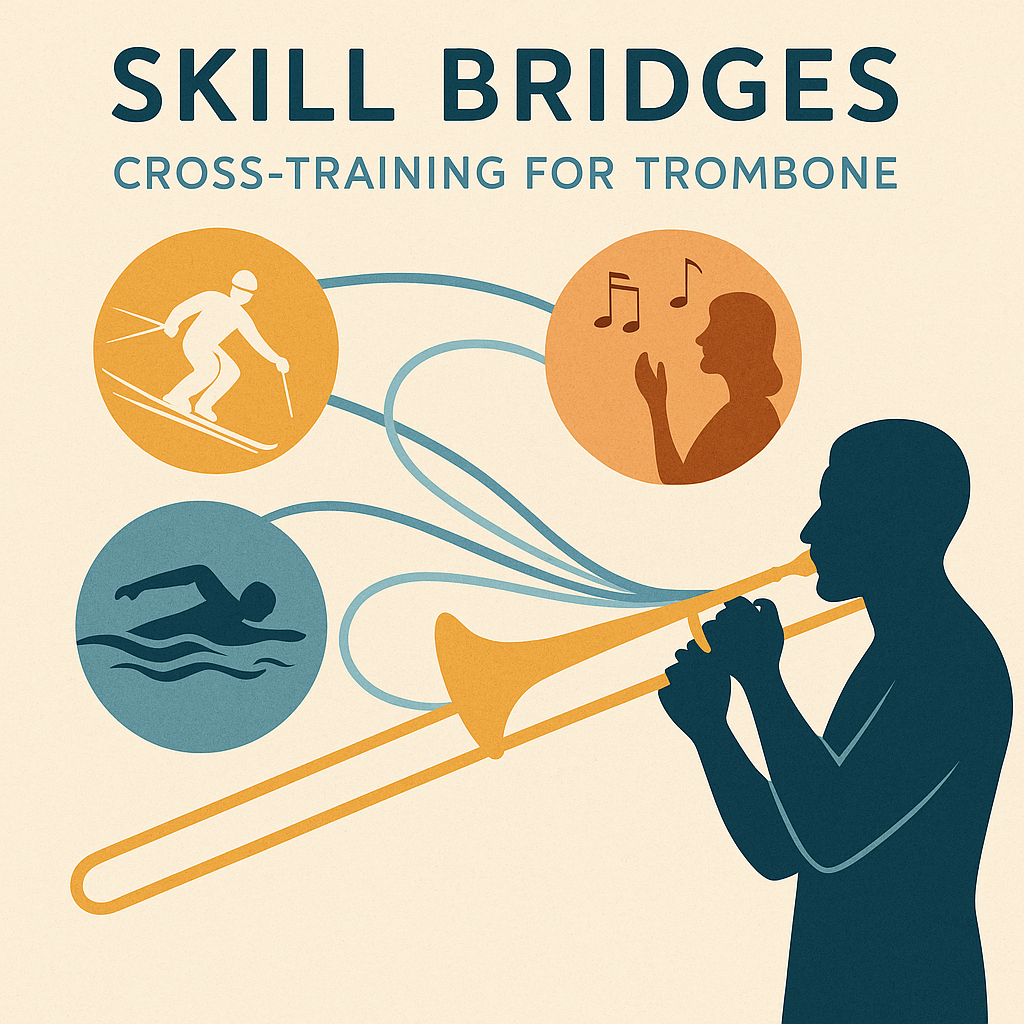
By Dr. Logan Chopyk – Spectrum Sound Studio Every brass player eventually encounters a barrier so stubborn that no amount of traditional practice seems to help. Some struggle with chronic tension. Others find themselves locked into inefficient breathing patterns. For a small but significant group—especially those experiencing severe imbalance or focal task-specific dystonia—the very act Read more
-
Skill Bridges, Part II: How Energy Exchange in Skiing, Skating, and Cycling Transforms Your Trombone Sound
By Dr. Logan Chopyk – San Diego Trombone Lessons Whether you’re learning trombone, teaching brass, or performing professionally, you can borrow experiences from other activities to teach yourself to play trombone with flow, efficiency, and joy: The way you surf a wave; carve snow on skis; shred with a longboard on asphalt; take high speed Read more
-
Skill Bridges, Part 1: Cross-Training and Transfer of Skill for Trombone Players
How First-Hand Experience in Parallel Activities Teach Us Aspects of Trombone Playing By Dr. Logan Chopyk – Spectrum Sound Studio Most trombonists have had this experience: you step away from the instrument—maybe to ski, swim, sing, or even play another instrument—and suddenly something about your trombone playing becomes clearer. Your breathing feels easier. Your timing Read more
-
Unlocking Potential: How Music Lessons Can Empower Children on the Autism Spectrum
At Spectrum Sound Studio, I believe every child is uniquely musical — including children on the autism spectrum. Engaging in music lessons isn’t just about learning an instrument. For kids on the autism spectrum, it can open doors to self-expression, communication, sensory regulation, and joy. Here’s how. 1. Music as a Bridge to Communication & Read more
-
Emotion Is Technique: A Mindful Pedagogy for Neurodiverse Musicians
By Dr. Logan Chopyk, Spectrum Sound Studio Discover how emotional awareness becomes foundational technique for neurodiverse music students—how a short awareness practice can overcome what appear to be technical blocks and instead become meaningful motion, regulation, and growth. Introduction In my work at Spectrum Sound Studio, teaching music to students on the autism spectrum and Read more
-
The Power of Flow: How Deep Engagement Unlocks Potential in Autistic Learners
The Power of Flow: How Deep Engagement Unlocks Potential in Autistic Learners How Spectrum Sound Studio uses flow to make music lessons transformative Parents often ask me what makes my teaching approach different — why students who have struggled with focus, frustration, or motivation elsewhere suddenly begin thriving here.The answer is flow. At Spectrum Sound Studio, everything Read more
-
When a Special Interest Becomes a Bridge: How Music Lessons Can Open Daily Life for Autistic Learners
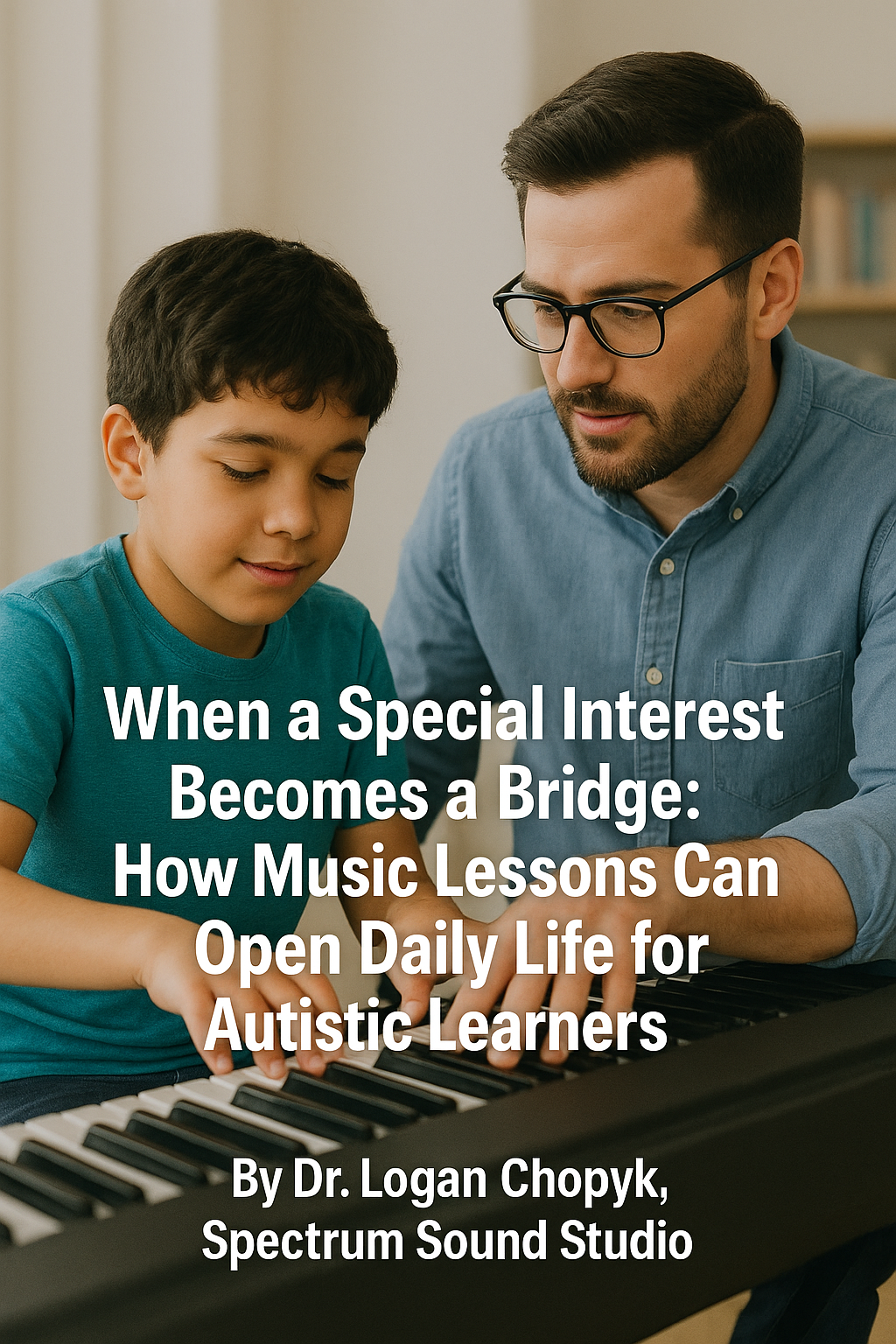
By Dr. Logan Chopyk, Spectrum Sound Studio At Spectrum Sound Studio, we deeply believe that for many autistic learners, the powerful intensity of their love for music is not a limitation—but a door. What we once viewed as “narrow focus” is increasingly understood in research as a gateway to communication, confidence, and meaningful participation in daily life. Why special Read more