How First-Hand Experience in Parallel Activities Teach Us Aspects of Trombone Playing
By Dr. Logan Chopyk – Spectrum Sound Studio
Most trombonists have had this experience: you step away from the instrument—maybe to ski, swim, sing, or even play another instrument—and suddenly something about your trombone playing becomes clearer. Your breathing feels easier. Your timing feels more grounded. Your sound feels more connected and less effortful.
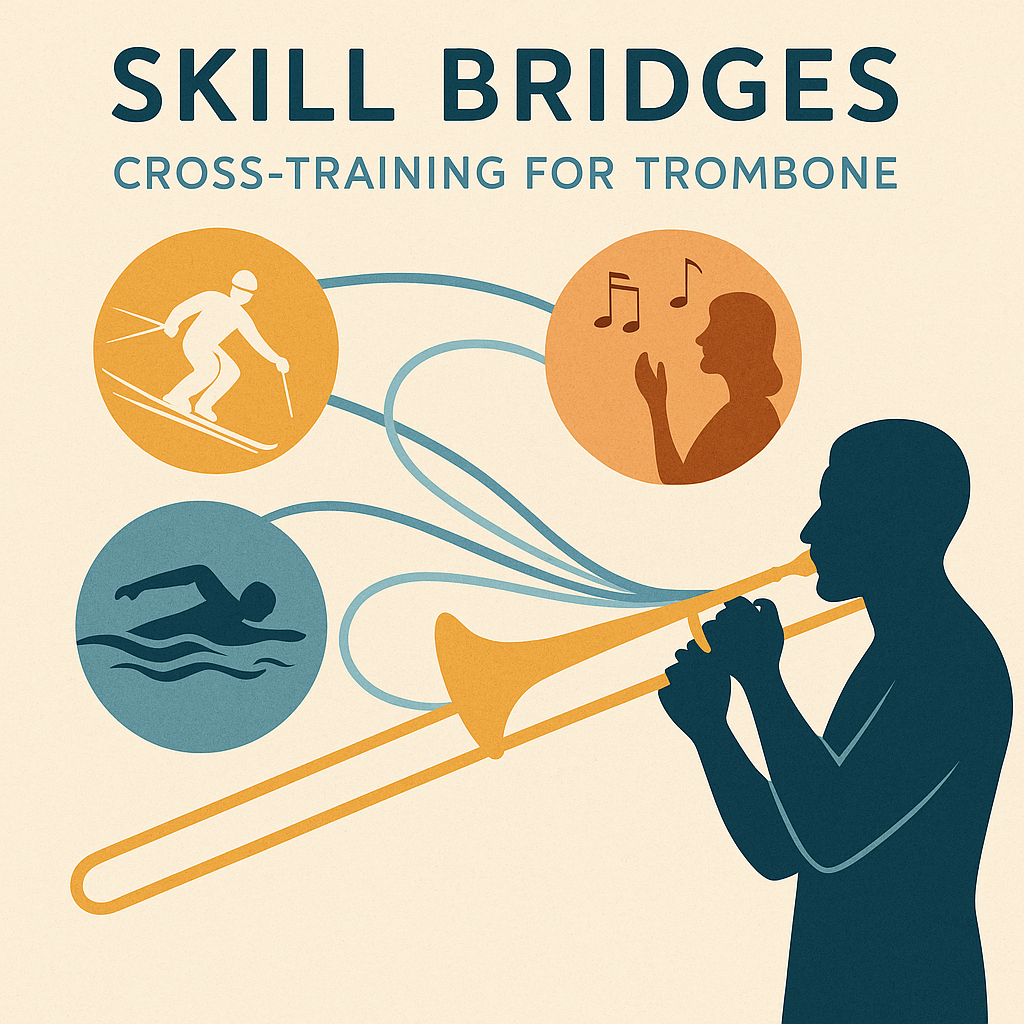
Those moments are not accidental. They are examples of transfer of skill, the well-researched phenomenon in which learning in one context improves performance in another. In my teaching, I call these moments Skill Bridges—connections between the activities you already do and the skills you need to play trombone fluently and efficiently.
Skill Bridges are essentially cross-training for musicians. Just as athletes train in multiple modalities to build coordination, balance, and resilience, musicians can develop powerful supporting skills through a variety of physical, musical, and artistic experiences.
This first article lays the scientific foundation behind Skill Bridges. In future posts, we’ll explore specific bridges—skiing, singing, body awareness, and more—but first, let’s look at why this approach works so well for brass players.
What Are Skill Bridges?
Skill Bridges are the intentional connections you form between non-trombone activities and the core physical and musical skills of playing.
These bridges emerge when you draw parallels—consciously or intuitively—between:
- Effortless Breath and flow you feel while swimming or playing another wind instrument
- Balance and flow you find while skiing
- Musical line and resonance you experience from singing
Skill Bridges don’t replace practice—they enhance it. They give your brain and body more ways to understand the sensations and mechanics of healthy brass playing. Oftentimes, they allow us to bypass the walls we run into when only practicing our primary instrument.
Cross-Training for Musicians
The idea of cross-training is simple: athletes don’t improve by repeating the same drill endlessly. They improve by engaging a network of related movement patterns through varied activities.
Musicians benefit from the same principle.
Cross-training helps you:
- Develop breath coordination
- Improve balance and posture
- Build rhythm as a physical skill rather than a mental one
- Reduce unnecessary tension
- Expand musical imagination
This is not metaphorical. It is grounded in well-established science about how humans learn movement.
The Science Behind Skill Bridges: Transfer of Learning
In educational psychology and motor learning research, transfer of learning refers to using knowledge or skills from one context in a new situation.
Researchers define:
Positive transfer
When previous skills help you learn something new
(e.g., breath timing from swimming improving brass playing)
Negative transfer
When an old habit interferes with a new skill
(e.g., shallow chest breathing conflicting with open brass breathing)
Near transfer
Transfer between similar tasks
(trombone → bass trombone, etude → solo)
Far transfer
Transfer between very different tasks
(skiing → stability and flow, singing → resonance and phrasing)
These terms are consistently defined across education and motor learning literature.
Skill Bridges deliberately lean into far transfer, where some of the most creative breakthroughs occur.
Why Cross-Training Works: Practice Variability & Contextual Interference
A major reason Skill Bridges work is that they introduce practice variability—a key factor in long-term learning.
Decades of research show that varying practice conditions (known as the contextual interference effect) often leads to stronger retention and better transfer than blocked, repetitive practice.
A recent meta-analysis (2024) confirms that random or interleaved practice improves transfer of motor skills, especially in adults.
Sport scientists have also explained these findings in clear terms: varied contexts create “desirable difficulty,” making skills more adaptable.
Importantly, music research mirrors this trend:
- Piano students show better learning when their work is interleaved.
- Beginning band students performed better after interleaved practice compared to blocked.
- Music educators have begun recommending mixed practice schedules for improved retention.
Skill Bridges function as a macro-level version of interleaving: instead of only varying music tasks, you vary whole categories of experience, giving your brain richer data to draw from.
Analogy Learning: Why Movement Imagery Helps Brass Players
Skill Bridges also take advantage of a powerful learning method known as analogy instruction, which research shows enhances skill acquisition, reduces overthinking, and improves performance under pressure.
Systematic reviews demonstrate that analogy-based cues improve motor performance across sports and movement skills compared to technical, step-by-step instructions.
Experiments in fields like basketball and high jump show that analogies can speed up the motor learning process.
Studies in tennis confirm that analogy cues outperform explicit instructions for beginners and advanced players.
Youth athletes learn faster when given simple images (“swing like a hammer”) rather than mechanical descriptions.
Skill Bridges are essentially “analogy learning made physical.”
Instead of imagining a movement analogy, you go out and do it—skiing, swimming, singing, drumming—so the embodied experience becomes a powerful learning shortcut.
What’s Coming Next
This first post lays the groundwork:
- You now know what Skill Bridges are
- How cross-training supports brass playing
- Why transfer of skill makes this approach credible
- And how analogy, variability, and motor learning research back it up
In the next parts of this series, I’ll explore specific Skill Bridges:
- What skiing, ice skating, and skateboarding taught me about balancing on the sound
- How I learned to blow freely by playing the flute
- How I learned to trust my body by visulization in golf and cycling
- What running and hiking taught me about breathing effortlessly
Sometimes the most meaningful musical breakthroughs begin somewhere unexpected.
Further Reading (External Research Sources)
- A. Transfer of Learning / Transfer of Skill
- 1. Transfer of Learning — ScienceDirect (overview)
https://www.sciencedirect.com/topics/psychology/transfer-of-learning - 2. Transfer Talk — University of Delaware (positive/negative/near/far transfer)
https://research.udel.edu/wp-content/uploads/sites/68/2017/04/TransferTalk.pdf - 3. Goodwin University summary (short PDF explainer)
https://www.goodwin.edu/files/docs/cte/transfer-of-learning.pdf - B. Contextual Interference & Practice Variability
- 4. 2024 Systematic Review & Meta-Analysis (Frontiers in Psychology)
Czyż, Wójcik, & Solarska
https://www.frontiersin.org/articles/10.3389/fpsyg.2024.1322880/full - 5. Classic Review: Magill & Hall (1990)
https://journals.humankinetics.com/view/journals/jmld/2/1/article-p28.xml - 6. Sport Science Insider — “Contextual Interference Effect Explained” (very accessible)
https://www.sportscienceinsider.com/contextual-interference/ - 7. Interleaved vs Blocked Practice in Music (Frontiers in Psychology)
Carter & Grahn (2016)
https://www.frontiersin.org/articles/10.3389/fpsyg.2016.01251/full - 8. Blocked vs Random Practice in Beginning Band Students (Journal of Research in Music Education)
Stambaugh (2011)
https://journals.sagepub.com/doi/10.1177/0022429411414713 - 9. Piano Practice & Contextual Interference (student-friendly summary)
https://sophia.stkate.edu/cgi/viewcontent.cgi?article=1025&context=maed - C. Analogy Learning & External Focus
- 10. Systematic Review & Meta-Analysis on Analogy Instruction (PMCID)
https://www.ncbi.nlm.nih.gov/pmc/articles/PMC9378310/ - 11. Scientific Reports (Nature): Analogies Speed Up Motor Learning
https://www.nature.com/articles/s41598-020-72441-9 - 12. Tennis Study: Analogy vs Explicit Instruction (Frontiers in Psychology)
https://www.frontiersin.org/articles/10.3389/fpsyg.2020.01157/full - 13. PLOS ONE: Coaching Cues & Analogies in Youth Motor Skill Performance
https://journals.plos.org/plosone/article?id=10.1371/journal.pone.0235375 - 14. Analogy Learning in Basketball (Baltic Journal of Health and Physical Activity)
https://www.balticsportscience.com/journal/2017-9-3/analogies-and-movement-skills - D. General Motor Learning / Transfer Resources
- 15. Motor Learning and Control (general topic overview)
https://www.humankinetics.com/pages/motor-learning - 16. Motor Skill Transfer (open textbook chapter)
https://pressbooks.bccampus.ca/knml/chapter/transfer-of-learning/