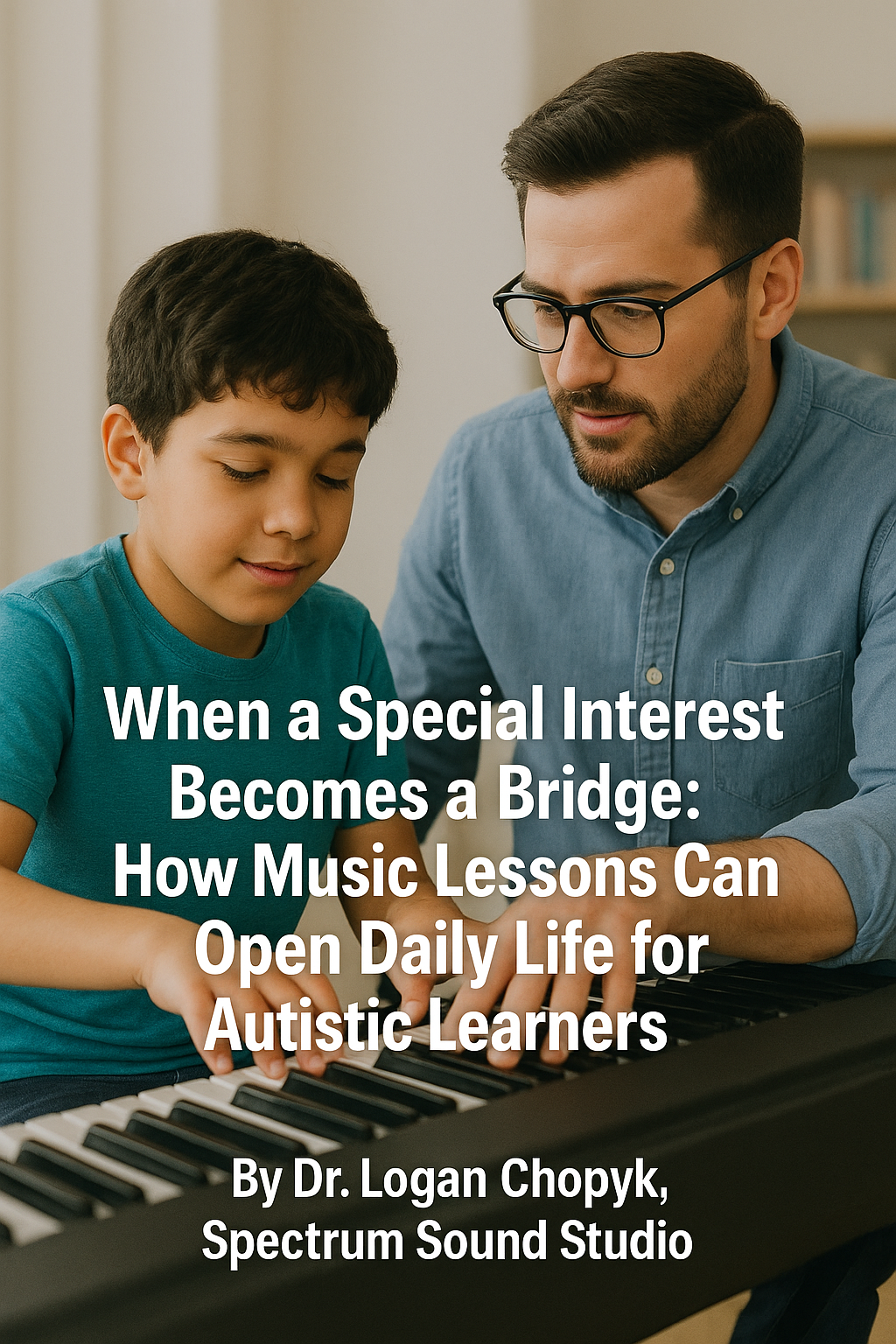
By Dr. Logan Chopyk, Spectrum Sound Studio

At Spectrum Sound Studio, we deeply believe that for many autistic learners, the powerful intensity of their love for music is not a limitation—but a door. What we once viewed as “narrow focus” is increasingly understood in research as a gateway to communication, confidence, and meaningful participation in daily life.
Why special interests matter—and how music fits in
Attention + Interest = Learning Fuel
One of the leading frameworks in autism research is the concept of monotropism: the idea that many autistic people tend to focus deeply on a small number of interests at a time. (National Autistic Society)
In simplified form: an autistic learner’s “attention tunnel” may narrow on a particular interest. That intense focus, when supported, becomes a powerful resource rather than a barrier. (Embrace Autism)
In practice, this means that a student’s “fixation” on a certain song, rhythm or musical theme can be the on-ramp for attention and learning—if we meet them there.
From “special interest” to functional life skills
Research in educational settings shows that embedding a learner’s circumscribed interest (sometimes called a “special interest”) into instruction boosts engagement, enhances motivation, and supports generalization of skills. (Autism Parenting Magazine)
In plain terms: when we align teaching and mentorship with what the autistic individual already cares about deeply, we increase the likelihood that new skills will “stick,” and transfer out of the lesson room into home, school, and community life.
Mentors & teachers: the influencers of interest pathways
There is growing evidence that trusted adults—mentors, teachers, instructors—play a key role in guiding how special interests evolve. For autistic adolescents, having a consistent, supportive non-parent adult has been associated with better social engagement and participation. (Frontiers)
In practical terms at Spectrum Sound Studio: our instructors not only teach music—they act as guides, helping channel a strong musical interest into broader goals (communication, self-advocacy, social connection) rather than leaving it isolated.
Music is uniquely positioned as a “bridge interest”
Why music? Because music naturally involves structure, repetition, social interaction, and routine—all of which align with what many autistic learners respond well to.
- Rhythm and beat support turn-taking, timing, and shared attention.
- Ensemble work invites collaboration in predictable, scaffolded ways.
- Songs and lyrics scaffold speech, memory, language sequencing.
Meta-analyses and systematic reviews of music-based interventions in autism report measurable benefits in social communication, joint attention, participation, and behaviour. (Frontiers)
More recent reviews (2024–25) show medium-effect improvements in behavioural symptoms with music therapy for autistic children (SMD ~ -0.66). (Frontiers)
And in the 2025 review “Music in Intervention for Children with Autism” (Zhao et al) the authors conclude: “Music interventions were found to have treatment effect in areas of communication, socialization and behavior of children with ASD.” (SpringerLink)
All of this suggests that music lessons—when properly structured and aligned with learner interests—can open pathways not just to playing an instrument, but to broader functional daily life.
How we turn music into life-skills at Spectrum Sound Studio
1) Start at the passion point
We begin where the learner’s interest already burns. Maybe it’s a favorite melody, a drum-beat loop, or a love of video-game soundtracks. We use that as our entry. That deep focus becomes our launching pad for attention, motivation, inclusion.
2) Build “interest bridges” outward
From that starting point we build toward broader goals:
- Communication & social skills: We use lyric‐fill ins, improvisation, songwriting, call-and-response to encourage requests, comments, musical turn-taking.
- Executive skills & routine: We embed checklists (set-up/tear-down), home practice plans, transitions tied to music routines, so that we’re not only playing music but building planning, sequencing, independence.
- Social participation: Duets, small ensemble, jam‐circle formats create predictable but social environments. Collaboration becomes natural.
We align with research that shows special-interest-based embedded teaching enhances generalization of skills. (Autism Parenting Magazine)
3) Mentorship that widens the world
We provide more than a music teacher: we provide a mentor. One who understands how special interests function for autistic learners, who can scaffold the interest into new directions (genre exploration, performance, peer collaboration) and supports self-advocacy (choosing repertoire, setting goals). This aligns with data showing mentorship increases social engagement and functional participation. (Frontiers)
4) Plan for generalization beyond the studio
A major challenge in autism supports is generalization—doing what we learn in one context into other contexts. We coordinate with families and schools so that musical routines map onto daily life routines: morning playlist for smoother transitions, metronome beats for brushing teeth, performing a mini-“show” in the home that doubles as a sequence of known tasks. Research emphasises that embedding interest in meaningful contexts increases transfer. (SpringerLink)
What progress can look like (with realistic expectations)
- Short term: More engaged lessons, better tolerance for transitions in/out of sessions, initial turn-taking in music, greater motivation for practice.
- Medium term: Measurable gains in communication attempts, shared attention, independent home practice routines; some carryover to classroom or home routines.
- Longer term: Broader social participation (e.g., ensemble, open mic), self-advocacy in choosing music and setting goals, life-skills confidence that transfers beyond music into school, job or community life.
The research supports that music-based interventions can help—but the quality of implementation, individual fit, and continuity matter. (Frontiers)
Your next step
If your learner has a strong interest in rhythm, melody, a song-loop or a soundtrack—let’s meet you where you are—and build outward from there. At Spectrum Sound Studio we’ll collaborate with you and your child, align with IEP or home goals, and help turn that passionate interest into functional skills and broader participation.
👉 Book a trial session, talk with us about alignment with home/school routines, ask how we partner with families.
Annotated Bibliography
- Edgar, H. & Adkin, T. (2025). What is monotropism? Understanding a neuroaffirming theory of autism. National Autistic Society.
- This article introduces the monoptropism concept: how autistic attention tends to focus deeply on fewer interests. It provides a neuro-affirming framework for viewing special interests as strengths rather than deficits. (National Autistic Society)
- Ke, X., Song, W., Yang, M., Li, J., & Liu, W. (2022). Effectiveness of music therapy in children with autism spectrum disorder: A systematic review and meta-analysis. Frontiers in Psychiatry.
- This meta-analysis of eight randomized controlled trials (608 participants) found that music therapy was associated with significant increases in social reactions among autistic children, though effects on symptom severity or speech were not significant. (Frontiers)
- Gao, X., Xu, G., Fu, N., Ben, Q., Wang, L., & Bu, X. (2024). The effectiveness of music therapy in improving behavioral symptoms among children with autism spectrum disorders: A systematic review and meta-analysis. Frontiers in Psychiatry.
- A large review (13 studies, 1,160 participants) finding substantial improvements in behavior symptoms (SMD = -0.66) when music therapy was used with autistic children. Highlights the potential for broader functional gains. (Frontiers)
- Zhao, L., Wang, Y., & Zhang, Z. (2025). Music in intervention for children with autism: A review of the literature and discussion of implications. Current Psychology, 44:4411-4421.
- A recent review that consolidates varied music-intervention research (17 selected articles) and emphasizes implications for educational settings—especially for generalizing skills and integrating into daily life. (SpringerLink)
- Murray, D., & Lawson, W. (2015). Monotropism: An interest-based account of autism. (Published by Monotropism.org)
- Foundational work introducing the interest-based model of autism: that autistic intense interests aren’t simply “obsessions” but deeply meaningful attention systems. This frames how special interests can be leveraged. (Monotropism)